
- 1. What a scab actually is
- 2. What a normal scab looks like
- 3. Black scabs
- 4. Yellow, green or grey crust
- 5. A wound that will not scab
- 6. Should you pick a scab off?
- 7. Why vets keep wounds moist, not dry
- 8. When it is not a wound at all
- 9. When to see a vet
- 10. Clinical cases
- Frequently asked questions
- Related guides
1. What a scab actually is
A scab is dried wound fluid: a mixture of clotted blood, serum proteins, fibrin, inflammatory cells and dead cells that has dried on the surface. It forms naturally whenever a wound is left open to the air, and it does one genuinely useful job — it is a physical barrier that keeps dirt and bacteria out while the skin underneath starts to repair.
What it is not is the thing that heals the wound. That happens underneath, in the layer of living tissue: new blood vessels grow in, granulation tissue fills the defect, and epithelial cells migrate across the surface from the edges. The scab is the roof. The repair is happening in the room below.
Key point: a scab is a sign that the surface has dried, not a sign that the wound is healing. Vets judge healing by what is happening underneath — granulation, contraction, and epithelial migration — not by the presence of a crust.
2. What a normal scab looks like
- Colour: dark red, rust, brown or near-black when fresh blood has dried. It lightens and separates as it matures.
- Shape: it follows the wound, and its edges curl away from the skin as the edges dry and the skin underneath closes.
- Surrounding skin: not swollen, not hot, not spreading red, and not painful to touch.
- Underneath: a thin scab over flat pink or grey-white new skin. No pus, no discharge, no smell.
- Timeline: a scab separates and falls off on its own once the skin below has closed, often one to three weeks for a small wound. Larger wounds take longer, and the edges may become crusted in stages.
The single most useful test an owner can do is compare the wound today with the wound three days ago. Progressing healing means the wound looks the same or smaller, and the surrounding skin looks normal. It does not mean the scab looks impressive.
3. Black scabs
A black or very dark crust is the finding owners worry about most, and it has two very different explanations.
| What it is | What it looks like | What to do |
|---|---|---|
| Dried blood — the normal scab | Thin, dark red to black, tightly or loosely attached to the surface; surrounding skin normal; wound either the same size or smaller | Leave it alone. It will separate on its own |
| Necrotic tissue (eschar) — dead skin | Very dark, leathery or hard, often a defined patch after a burn, pressure injury, or severe infection. May be stuck to the wound like a plate | Needs a vet. Dead tissue has to be removed; the wound cannot heal while it is present |
| Infection or gangrene underneath | Black crust with pus, foul smell, spreading redness, swelling, heat, an enlarging wound, or a systemically unwell dog | Urgent. This is an emergency if the dog is also lethargic, off food or feverish |
The tell is not the colour of the crust; it is what surrounds it. A black scab on a wound that is otherwise dry, quiet and shrinking is usually just dried blood. A black, hard patch on skin that is red, swollen, warm and spreading is dead tissue, and it needs veterinary attention today.
4. Yellow, green or grey crust
- Yellow crust or yellow-grey material: dried pus. Pus is the single clearest sign of bacterial infection on a wound surface — neutrophils and dead bacteria.
- Green or blue-green discharge: classically associated with Pseudomonas, an organism common in wounds that have been treated repeatedly, and often resistant to several antibiotics. It also has a distinctive sweetish, unpleasant smell.
- Grey, wet, soggy crust: macerated, over-moist skin with bacterial overgrowth — often under a bandage that has stayed wet too long, or where the wound is in a skin fold.
- Thick brown-black debris in a greasy ear or skin fold: not a scab at all, usually a yeast overgrowth, which routinely comes with a musty smell.
If the crust is any of these, the question is not whether to remove it but what organism is underneath it, and that is answered by a swab and cytology rather than by guessing. This applies particularly to a wound that has already had one course of antibiotics, where resistant bacteria are more likely.
5. A wound that will not scab
Owners often interpret a wound that stays moist and open as the wound "not healing". In fact, a persistent, non-scabbing, exuding wound is usually a wound with one of a short list of identifiable problems:
- Infection. Bacteria keep the surface inflamed and weeping. This is the most common reason.
- The dog is licking or chewing it. Saliva and friction keep the surface wet and contaminated, and the wound cannot get ahead. The majority of non-healing wounds seen in practice have this component.
- Dead or foreign material in the wound. A foreign body — a grass awn, a splinter, a fragment — a piece of necrotic tissue or a suture abscess will keep a wound open indefinitely until it is removed.
- Moisture and maceration. A bandage or dressing kept too wet, or a wound in a skin fold, keeps the skin soggy and delays closure.
- A large defect. A wound that has lost a substantial area of skin cannot close by contraction alone, and it will stay open until it is either dressed properly for long enough or reconstructed.
- Underlying disease. Poor protein levels, hormonal disease, a tumour in the wound, or a dog on immunosuppressive medication will not heal normally.
An important nuance: for many modern wound dressings, a wound that is kept in a controlled moist state will not form a hard scab at all — and that is intentional. A dry, hard crust slows down the migration of new skin cells across the surface. "Not scabbing" is not automatically a bad sign; it depends entirely on what the wound bed looks like underneath.
6. Should you pick a scab off?
No. Leave it. Picking a scab:
- Re-opens the wound and causes fresh bleeding
- Destroys new epithelium that has already grown in underneath
- Introduces bacteria from fingers and nails into a wound that was closed
- Increases inflammation and itch, so the dog then interferes with it as well
- Restarts the healing clock, often back to the beginning
The exceptions are all veterinary decisions rather than owner decisions: removing dead tissue from a wound bed, opening a pocket of pus, or removing a crust that is trapping discharge underneath. Those are done after cleaning and, where needed, sedation — and they are a different action from picking at a scab in the living room.
7. Why vets keep wounds moist, not dry
This is the part that surprises most owners. For decades the standard advice was "let it dry out and form a scab". Modern wound management deliberately does the opposite for many wounds, and the reason is cellular:
- Epithelial cells migrate faster over a moist surface. Skin cells have to crawl across the wound bed from the edges. On a dry crust they move slowly; in a moist environment they move considerably faster.
- A dry crust is dead tissue sitting on the wound, and it can shield bacteria underneath while blocking the tissue fluid that helps the wound clean itself.
- Dressing changes hurt less and cause less damage when the wound surface has not dried onto the dressing.
- Excess fluid still has to be managed. "Moist" is not "soaked" — a wound swimming in discharge macerates the surrounding skin and delays healing.
That balance — moist but not soaked, clean but not scrubbed, covered but not sealed tight — is what a wound dressing and a wound-contact material are for. It is also why our clinical protocols repeatedly describe wounds healing without premature scabbing: the surface is kept in the state that lets the tissue underneath get on with the repair.
8. When it is not a wound at all
A lot of "scabs" on dogs are not the crust of a wound, and treating them as one wastes time:
- Mange (Sarcoptes, Demodex or Cheyletiella) produces scaling, crusting and hair loss, typically around the face, ears and feet. It is intensely itchy, and it needs specific treatment.
- Ringworm produces circular bald patches with a scaly rim, particularly on the head and limbs, and is contagious to people and other pets.
- Bacterial and yeast skin infection produces crusts and greasy, musty debris on the skin surface, often in skin folds.
- Hot spots become crusted as they dry up, after the acute weeping stage — the crust here is part of resolution, but the trigger still has to be found.
- Seborrhoea and other skin diseases can produce a greasy or scaly coat that mats and looks crusted, without any wound at all.
The distinguishing features are straightforward: a wound has a defined cause and a direction of travel, hair loss is limited to the damaged area, and the crust is on top of a defect. Generalised scaling with hair loss, particularly with intense itch, is a skin disease and should be worked up as one.
9. When to see a vet
- The dog is unwell, off food, lethargic or feverish
- The wound is enlarging rather than shrinking
- There is pus, a foul smell, or green discharge
- Surrounding skin is red, hot, swollen and spreading
- The skin around the wound is black or leathery, or the wound contains dead tissue
- The dog will not stop licking or chewing it — a wound that keeps being interfered with will not close
- It has been more than two to three weeks without clear, steady improvement
- A deep wound, a wound that may have a foreign body in it, or a wound that has been there long enough to look like a lump
- Any wound in a dog with diabetes, hormonal disease or on immunosuppressive medication
Materials used when a wound will not close
Our ECM regenerative materials are veterinary surgical materials, applied by the treating veterinarian after the wound has been cleaned and debrided. The antibacterial powder is applied to the debrided wound bed and dressed, and ECM sponge is used to fill a cavity or a deeper defect. They are used as part of a wound management plan that controls infection, removes dead tissue and keeps the surface in the right condition for the skin to close.
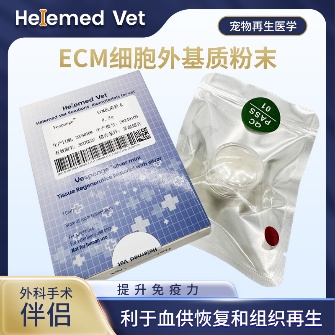
ECM Antibacterial Powder
ECM bioscaffold powder — an extracellular matrix (ECM) based antibacterial and inhibitory powder: widely used as ECM trauma dressings on infected internal/external wounds, fresh wounds, burns and crush injuries to markedly improve blood supply, accelerate healing, inhibit infection and reduce complications; it is also an ECM hemostatic material that stops capillary bleeding. How to use: after debridement, take a small amount of powder with forceps and apply to the wound surface, moisten with saline (moist wound healing) and bandage; apply once every 5 days — daily debridement is not required.
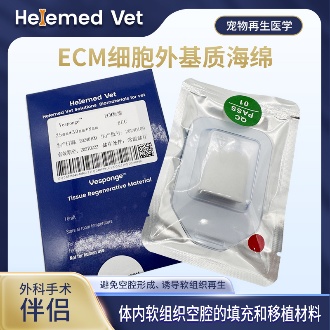
ECM Sponge
ECM filling sponge and ECM cavity-filling biomaterials: for internal soft-tissue cavity filling, providing long-lasting space occupation and inducing regeneration to achieve a soft-tissue graft effect; also an ideal ECM Tumor Filling Material for dead-space repair after tumor resection, and a routine companion to ECM trauma dressings in cavity and fistula wounds.
Ask your veterinarian whether these materials suit your dog's wound; they are supplied to veterinary clinics and hospitals.
10. Clinical cases
Both of these cases from our partner hospitals describe the same principle in practice: a wound kept in good condition that healed with no infection and no premature scabbing — one a fresh bite wound, one a small cavity that had not closed for over a month.
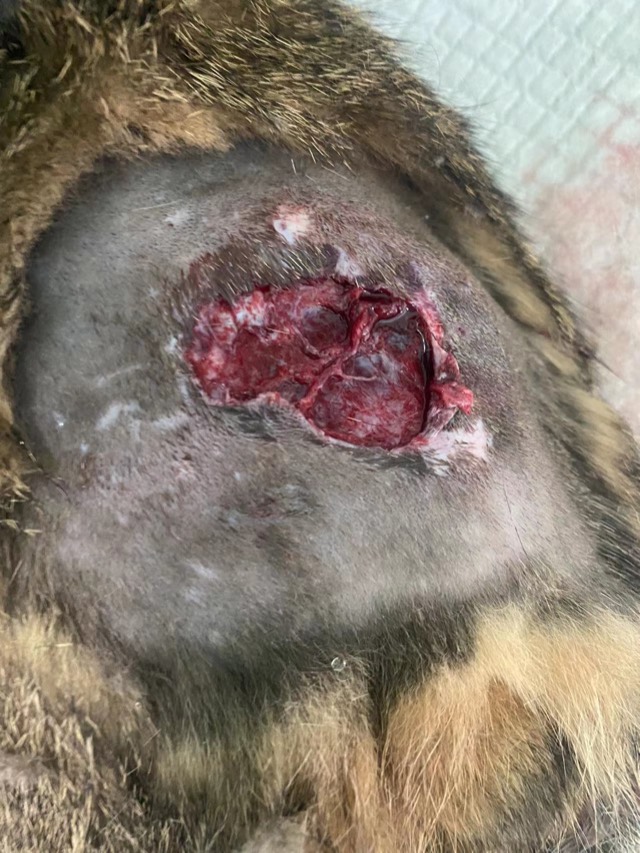
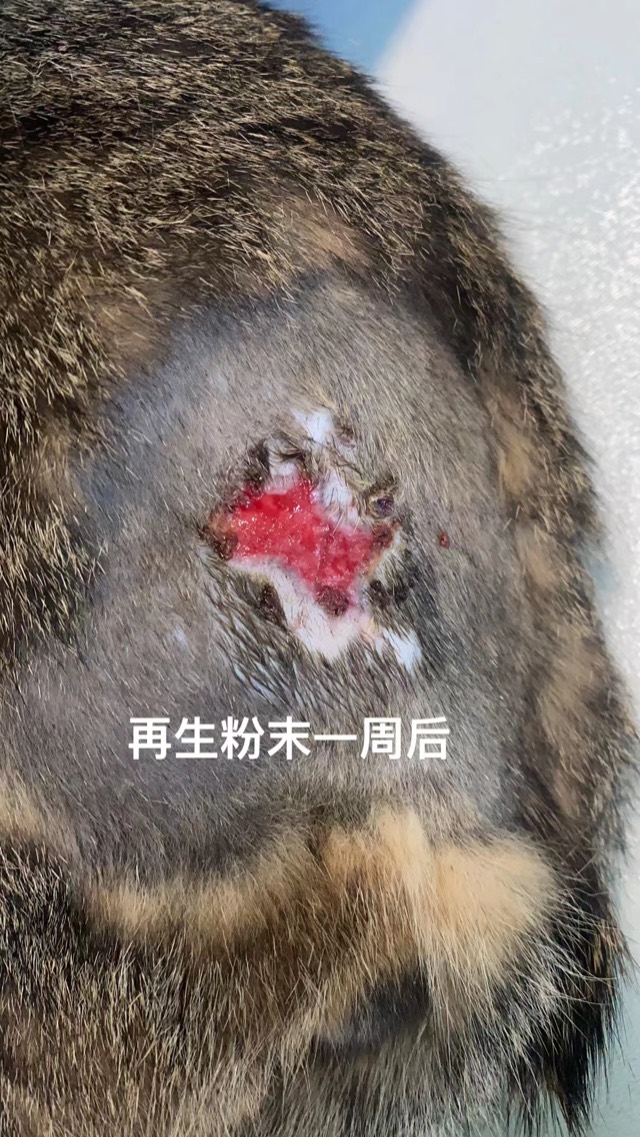
Bite-Wound Regeneration
After debridement and irrigation of the bitten, ulcerated wound, ECM Antibacterial Powder (ECM Inhibitory Powder) was placed on the wound, moistened with saline and bandaged with gauze. Re-check one week later showed the wound markedly reduced, with normal soft-tissue and surrounding-skin regeneration, no infection and no premature scabbing.
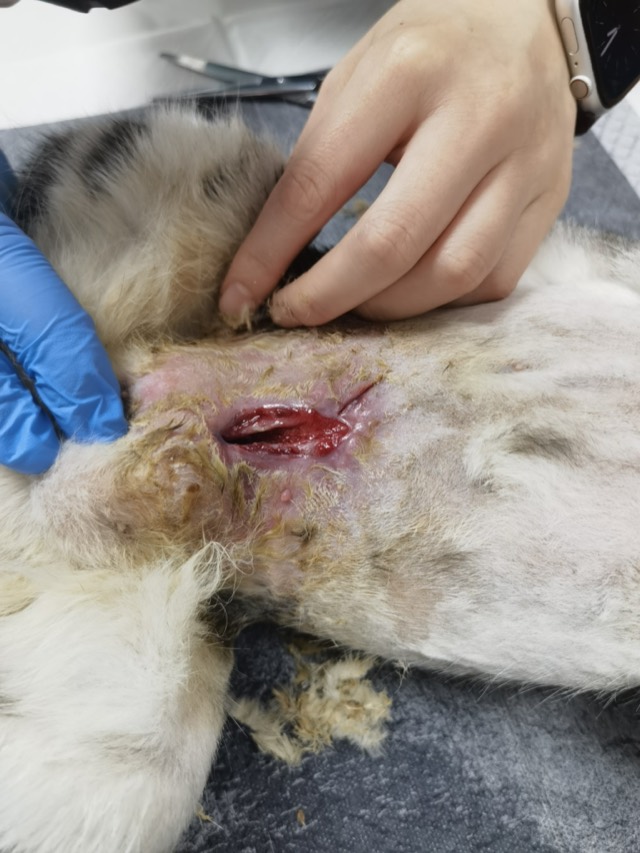
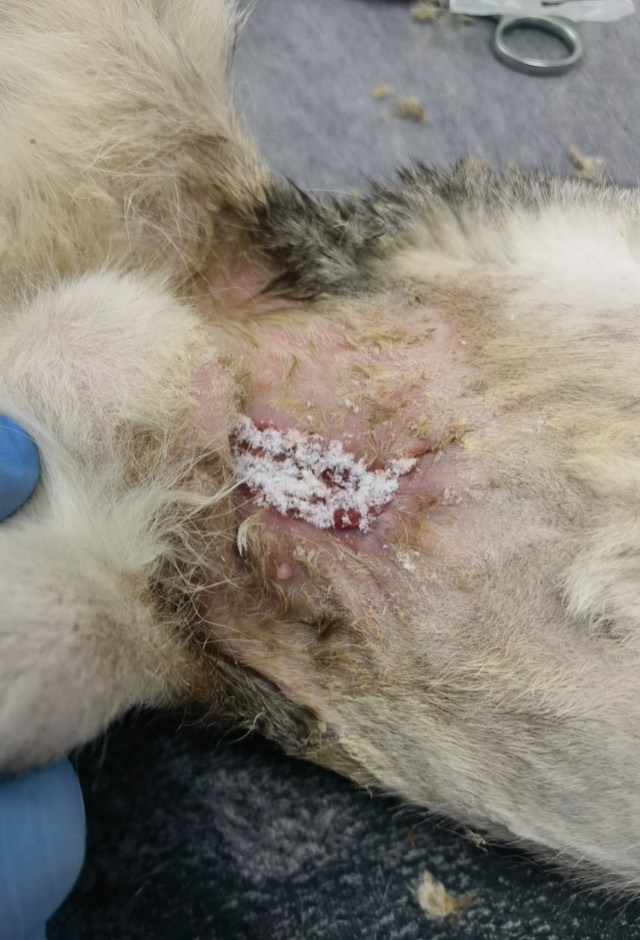
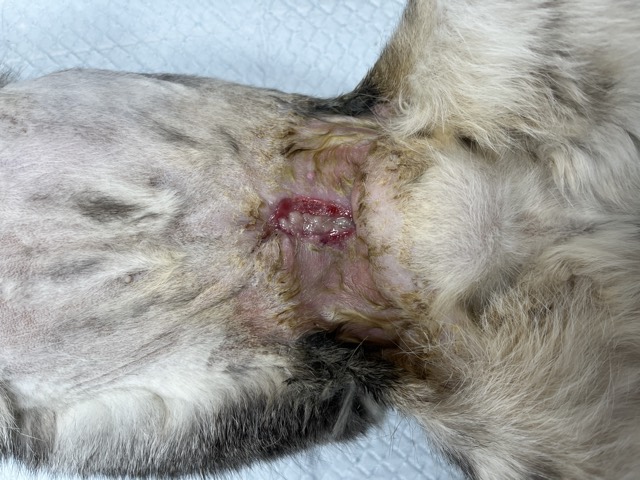
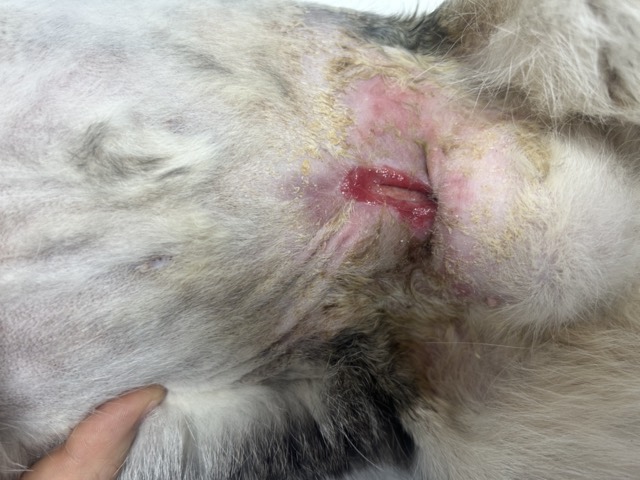
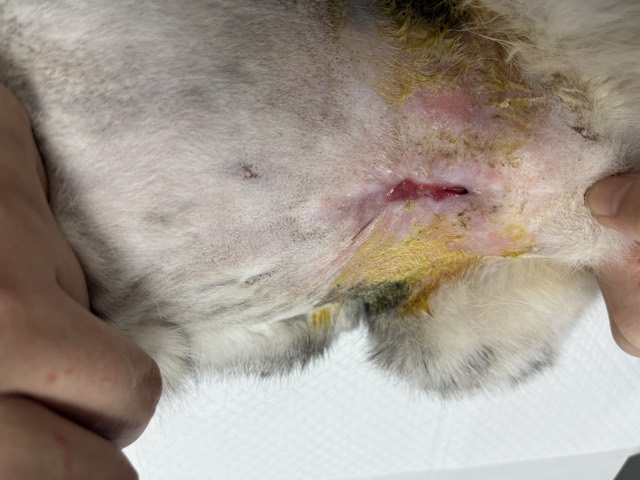
Small-Cavity Wound Healing
The wound failed to heal after more than a month of conventional treatment. ECM Antibacterial Powder was applied and bandaged on Jul 23; after two application cycles (10 days) the wound healed markedly with no infection or premature scabbing, and it fully recovered after one more cycle.
Cases from partner veterinary hospitals. ECM materials are veterinary surgical materials and are applied by the treating veterinarian, not at home. See all 39 clinical cases →
Frequently asked questions
Is it normal for a dog wound to scab?
A thin, dark scab over a clean wound that is shrinking and surrounded by normal skin is normal. What matters is the direction of travel: a wound that is the same size or smaller with quiet skin around it is healing, however the surface looks.
What does a black scab on a dog mean?
Usually it is dried blood, which is normal. It becomes a concern when the black area is hard and leathery — dead tissue — or when there is pus, swelling, redness or a smell underneath it. A black crust with spreading inflammation needs to be seen the same day.
Why is my dog’s wound not scabbing?
Common reasons are infection, the dog licking or chewing the area, a foreign body or dead tissue in the wound, a dressing kept too wet, or a defect too large to close by itself. Note that a wound deliberately kept in a moist dressing environment will not form a hard scab, and that is correct practice rather than a problem.
Should I remove the scab from my dog’s wound?
No. Picking a scab off re-opens the wound, damages the new skin underneath, introduces bacteria and restarts healing. Removing dead tissue or a crust that is trapping pus is a veterinary procedure, not something to do at home.
What does an infected scab look like?
Yellow or green discharge, a foul smell, spreading redness and swelling around the wound, heat, increasing pain, and a wound that gets bigger rather than smaller. In a severe infection the dog may also be lethargic, off food or feverish.
How long should a scab take to fall off?
A small wound commonly takes one to three weeks for the crust to separate on its own, and it should be accompanied by the wound getting smaller and the surrounding skin staying quiet. If nothing has changed in two to three weeks, have it looked at.
Can I put human antiseptic or ointment on a dog scab?
No. Alcohol, hydrogen peroxide and many human antiseptics damage the healing tissue, human antibiotic and steroid ointments can be licked off and swallowed, and some human preparations are toxic to dogs. Use only what your vet has prescribed.