
- 1. What a dog abscess actually is
- 2. Where abscesses form, and why
- 3. Signs your dog has an abscess
- 4. When an abscess is an emergency
- 5. Is it an abscess or a lump?
- 6. How a vet treats a dog abscess
- 7. What not to do at home
- 8. Aftercare: the first two weeks
- 9. Why an abscess comes back
- 10. Clinical cases
- Frequently asked questions
- Related guides
1. What a dog abscess actually is
When bacteria get under the skin, the immune system floods the area with white cells and fluid. The result is pus: dead cells, dead bacteria, tissue fluid and debris. The body then does something clever and inconvenient — it builds a wall of fibrous tissue around the pus to stop the infection spreading. That walled-off pocket is an abscess.
Two consequences follow from that structure, and everything about treatment flows from them:
- The pus cannot get out. It has no drainage route, so pressure builds. That is the throbbing pain, and it is why an abscess eventually "points" — thins the skin over it and ruptures on its own.
- Antibiotics alone cannot fix it. Blood supply to the inside of the capsule is poor, so the antibiotic concentration inside the pus is low. The pus has to be physically removed. Antibiotics come after drainage, not instead of it.
The one-line rule: an abscess is a surgical problem with a medical follow-up. Drain first, antibiotics second.
2. Where dog abscesses form, and why
| Type | Typical cause | Where you see it |
|---|---|---|
| Bite-wound abscess (the most common) | A dog or cat bite drives oral bacteria deep under the skin. The puncture hole seals within hours and traps them. | Neck, face, shoulder, rump, legs. Often a soft lump appearing 3–7 days after a scuffle. |
| Foreign-body abscess | A grass awn, splinter, thorn or grit stays inside the tissue. | Feet, between the toes, flank, under the chin. |
| Tooth-root (dental) abscess | Deep periodontal disease or a fractured tooth lets bacteria into the root canal. | Swelling under the eye or along the upper jaw; bad breath, drooling, chewing on one side. |
| Anal sac abscess | An impacted anal sac becomes infected and ruptures through the skin. | Either side of the anus. The dog scoots, licks and may yelp when it sits. |
| Post-surgical abscess | A suture reaction, a dead space left under the incision, or a low-grade infection. | At or beside the operation site, often 1–3 weeks after surgery. |
| Internal abscess | Liver, prostate, uterus or abdominal cavity. | No visible lump. The dog is simply ill — fever, lethargy, not eating. |
Bite wounds deserve the emphasis. A puncture looks trivial from the outside, and the swelling appears days later once the pocket is under pressure. If a dog has been bitten and there is the smallest puncture, it needs a veterinary assessment, not observation — see Dog Wound Care for how bite wounds are handled on the day.
3. Signs your dog has an abscess
- A new dog lump that appeared over 2–5 days and is growing
- The lump is hot, and clearly painful — many dogs will not let you touch it
- Hair over the lump stands up, or the skin looks stretched, shiny and reddened
- The dog licking and chewing at one spot constantly, or holding a leg up
- Fever (often over 39.5 °C / 103 °F), lethargy, going off food, or shivering
- Bad breath, drooling or facial swelling → suspect a tooth-root abscess
- Scooting, pain when sitting, or a swelling beside the anus → suspect an anal sac abscess
- A sudden wet patch and foul discharge with blood — the abscess has ruptured. The dog often seems relieved straight away because the pressure is gone.
That last point catches owners out. When an abscess ruptures, many dogs brighten up within hours and the owner assumes the problem is over. The cavity is still there, it is still contaminated, and it will fill up again and heal over unless it is opened, flushed and kept draining.
4. When a dog abscess is an emergency
Most abscesses can wait until the next working day. These cannot — call now:
- Fever with a dog that is dull, not eating or vomiting, or any abscess in a very young, very old or immune-compromised dog
- Swelling on the face, muzzle, throat or under the eye — a dental abscess that tracks towards the eye, or a mass that could narrow the airway
- An abscess over the chest, abdomen or a joint, or one that is spreading rapidly with red streaks in the skin
- An anal sac abscess that has ruptured or involves a swollen, painful hindquarter
- Any lump your dog will not let anyone touch, or a lump that is growing by the hour
- Lethargy, collapse, laboured breathing, or a swollen limb with a cold foot below it
5. Is it an abscess or a lump?
Owners searching for a dog lump, a lump on a dog's leg or a lump on a dog's belly are usually looking at one of two very different things: something that needs draining, or something that needs sampling. Most lumps in dogs are not abscesses.
| Feature | Abscess | Tumour or other lump |
|---|---|---|
| Speed of appearance | Hours to a few days | Weeks to months, often slow |
| Pain and heat | Marked — usually hot and sore | Usually neither, unless inflamed |
| Texture | Soft or springy in the middle, firm at the rim | Variable: soft (lipoma), firm, or "gritty" |
| Dog's general health | Often off colour, may have a fever | Usually bright and normal |
| Skin over it | Red, stretched, hair standing up, may rupture | Usually normal hair and colour |
| What settles it | Drainage | Sampling and, if needed, removal |
The only reliable way to tell is a fine needle aspirate: the vet inserts a needle into the lump, pulls back a few cells, and looks at them under the microscope. It takes seconds, and it distinguishes pus from fat from tumour cells. Most dog lumps are not abscesses, and a lump that is neither hot nor painful is unlikely to be one. That is why "just drain it and see" is a bad plan for a lump that is not hot, not painful, and not obviously an abscess — the test costs almost nothing and answers the question properly.
If the lump is not painful and not hot, do not wait for it to rupture. Book a fine needle aspirate. A large share of "abscesses" that turn out to be something else are found this way, early.
6. How a veterinarian treats a dog abscess
- Diagnose. Palpation, temperature, and usually a fine needle aspirate or a sample of the discharge for cytology and culture. Fever and general health determine how urgent it is. Dental and anal sac abscesses need their own assessment (dental X-rays, anal sac expression).
- Drain. Under sedation, the vet opens the abscess at its most dependent point so gravity helps, and removes the pus. "Dependent" matters: an opening at the bottom drains; an opening at the top just closes again.
- Breaking down the capsule. The fibrous wall is broken up with a finger or instrument so the pocket becomes one open cavity rather than several small ones, and any debris or foreign body is found and removed. This step is what stops an abscess recurring.
- Flush thoroughly. Large-volume lavage with sterile saline clears the remaining pus and bacteria. Some wounds are left open to drain for several days; a drain (usually a Penrose drain) may be sutured in place to keep the route open.
- Decide about the cavity — this is the step most owners have never heard of. After drainage there is an empty space where the pus was. If the skin is simply sutured over it, fluid accumulates again in the same pocket and the abscess returns. The cavity has to be either left open to drain and heal from the base outwards, or filled with a material the body can resorb while new tissue grows into it.
- Antibiotics, culture-guided where possible. Usually 7–14 days, and the full course — stopping early is one of the classic reasons for a second abscess. Pain relief and an Elizabethan collar are not optional extras.
Filling the cavity after drainage — where ECM materials fit
A drained abscess leaves dead space: a hollow under the skin with a poor blood supply. The two problems to solve are that fluid collects there, and that there is no scaffold for new tissue to grow into. Our ECM regenerative materials are veterinary surgical materials used by the treating veterinarian for exactly this step — after debridement and drainage:
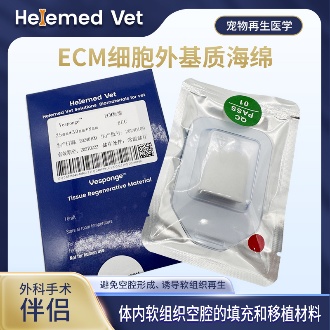
ECM Sponge
ECM filling sponge and ECM cavity-filling biomaterials: for internal soft-tissue cavity filling, providing long-lasting space occupation and inducing regeneration to achieve a soft-tissue graft effect; also an ideal ECM Tumor Filling Material for dead-space repair after tumor resection, and a routine companion to ECM trauma dressings in cavity and fistula wounds.
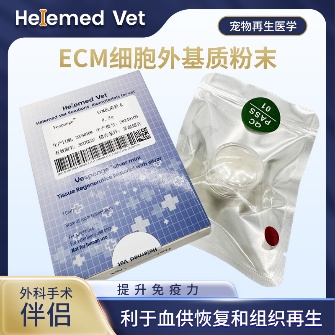
ECM Antibacterial Powder
ECM bioscaffold powder — an extracellular matrix (ECM) based antibacterial and inhibitory powder: widely used as ECM trauma dressings on infected internal/external wounds, fresh wounds, burns and crush injuries to markedly improve blood supply, accelerate healing, inhibit infection and reduce complications; it is also an ECM hemostatic material that stops capillary bleeding. How to use: after debridement, take a small amount of powder with forceps and apply to the wound surface, moisten with saline (moist wound healing) and bandage; apply once every 5 days — daily debridement is not required.
The ECM sponge is soaked in saline, squeezed out and packed into the cavity so the space is occupied while tissue regenerates into it; the antibacterial powder is applied to the debrided wound bed and dressed. These are clinic-supplied surgical materials — ask your veterinarian whether they suit your dog's case.
7. What not to do at home
- Do not squeeze or lance it yourself. You cannot see where the pus tracks, you cannot break down the capsule, and you risk pushing bacteria deeper or into the bloodstream. Also, it hurts — which is how owners get bitten.
- Do not give antibiotics from a cupboard or from a previous prescription. Wrong drug, wrong dose, wrong duration — and it makes culture results useless.
- Do not pour hydrogen peroxide or alcohol into it. Both are tissue-toxic and delay healing.
- Do not cover a draining abscess airtight. It needs to drain. A light, breathable dressing is enough.
- Do not assume a ruptured abscess is finished. It is the point where treatment usually starts, because the pus is now accessible.
What you can do, if a vet has told you the abscess is suitable for it: warm compresses (a clean cloth wet with comfortably warm water, 5–10 minutes, three times a day) help an abscess come to a point and drain. Keep the area clean, keep the dog from licking it, and keep the follow-up appointment.
8. Aftercare: the first two weeks
- Flush as instructed. Some vets ask you to flush the cavity with saline once or twice daily. Use the volume and technique you were shown, not more.
- Drain removal is usually at 3–5 days. Do not remove it yourself.
- Keep it draining. The opening must stay open until discharge stops and the cavity fills in. A scab over the opening seals it prematurely and traps fluid.
- Elizabethan collar, continuously. Licking is the most common cause of an abscess that heals over and then reforms.
- Rest, no swimming, no bathing until the vet clears the wound.
- Watch for the failure signs: fever returning, swelling coming back, discharge turning foul or blood-heavy, the dog going off food. Any of these means a recheck, not more waiting.
- Finish the antibiotics even if the wound looks perfect on day three.
9. Why an abscess comes back
- Incomplete drainage — the capsule was not broken down, or the opening was not at the dependent point, so a pocket remained.
- A retained foreign body — grass awn, splinter, bone fragment or a fragment of tooth. The wound will not settle until it is out.
- Dead space left unfilled after drainage, so fluid re-accumulates in the same place.
- Antibiotics stopped early, or the wrong antibiotic without culture.
- An underlying cause not treated — dental disease, an impacted anal sac, ongoing allergy-driven skin disease.
- Licking. Always the simplest explanation, and always worth checking first.
If your dog has had two or more abscesses in the same place, the question to ask your vet is not "which antibiotic?" but "was the cavity fully drained, and was there anything left inside it?"
10. Clinical cases
Two cases from our partner hospitals show the cavity problem in practice: a cavity left after surgery that needed filling, and a subcutaneous collection after bladder-stone surgery that would not close.
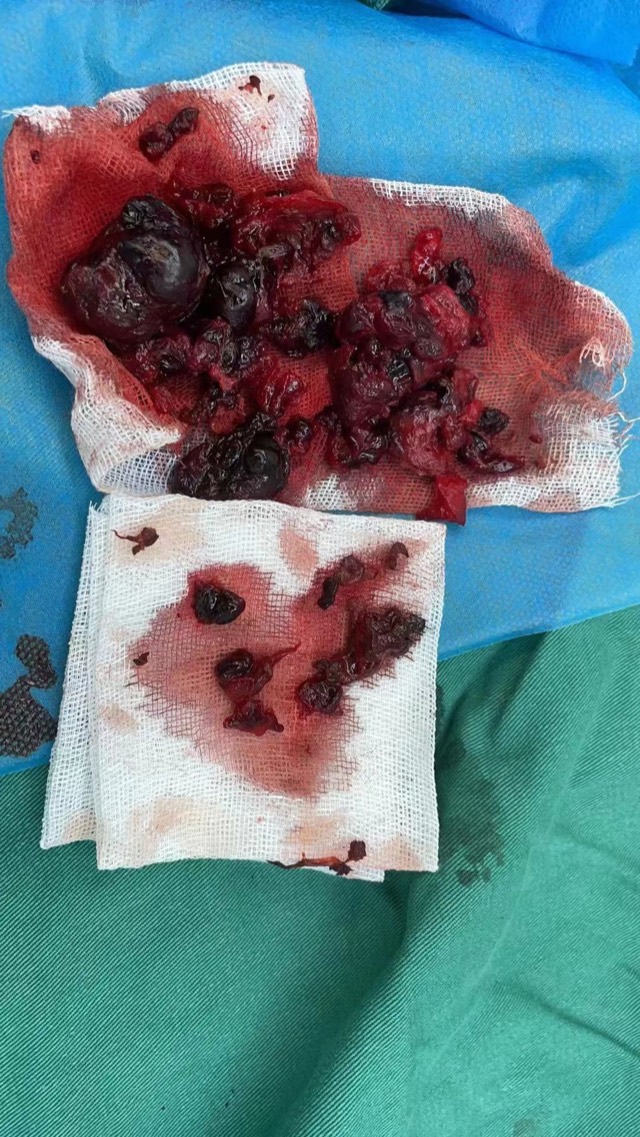
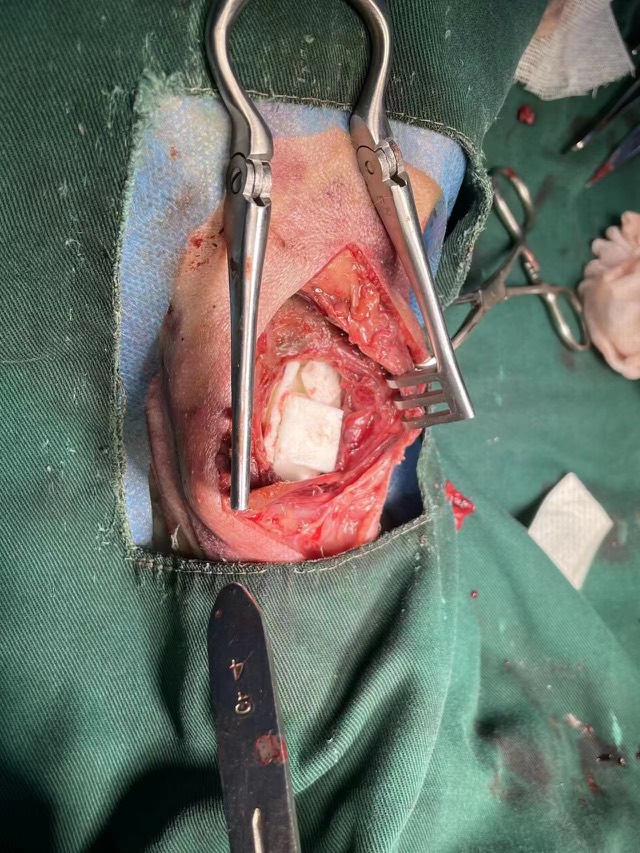
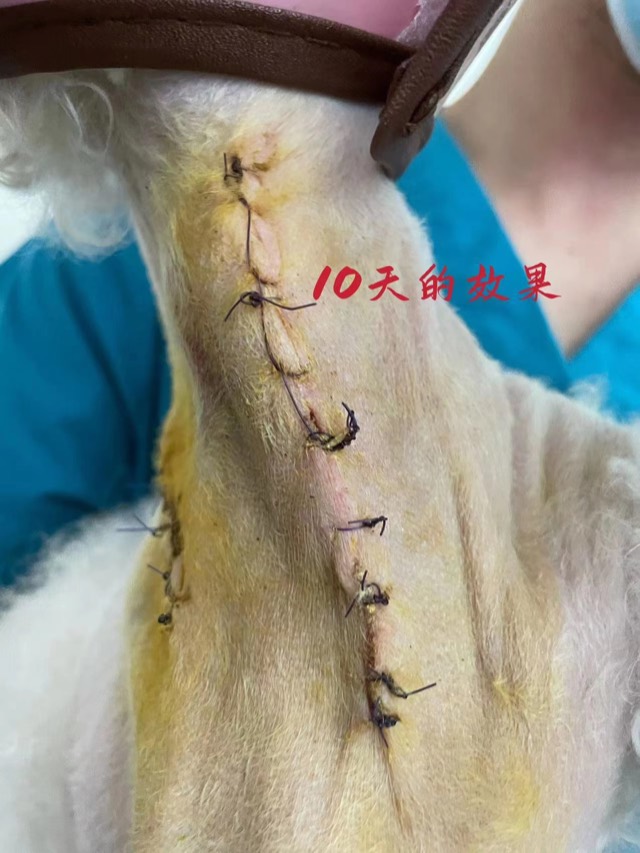
ECM Sponge Assisted Cavity Filling
When there is an obvious cavity with normal surrounding blood supply, ECM Sponge can assist filling (larger volume, ~20-day degradation, synchronized with new tissue). Before use, fully soak in saline and squeeze out excess water.
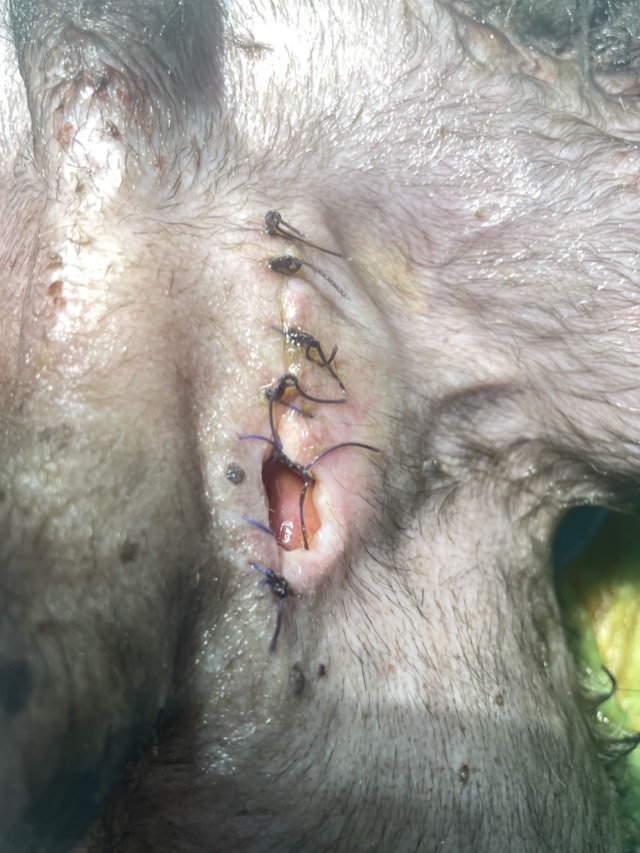
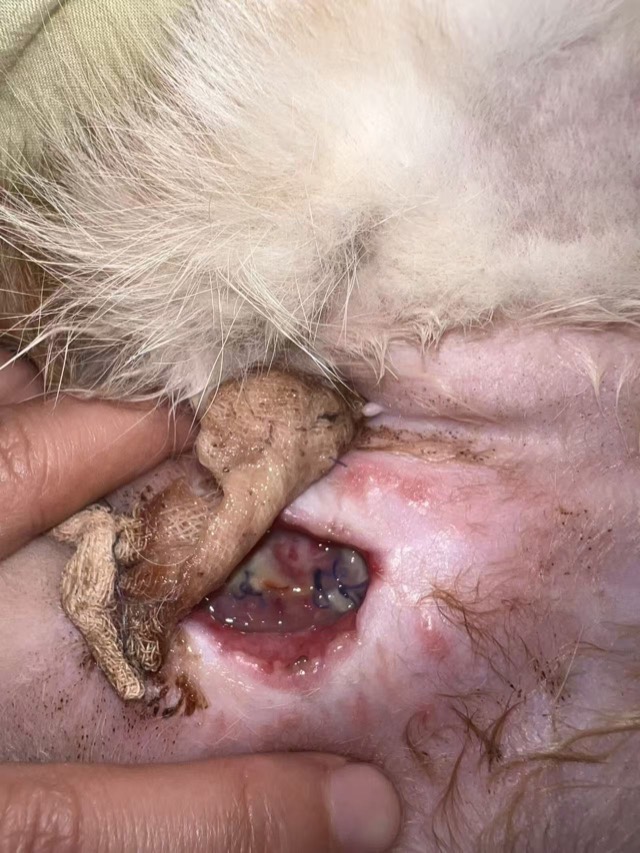
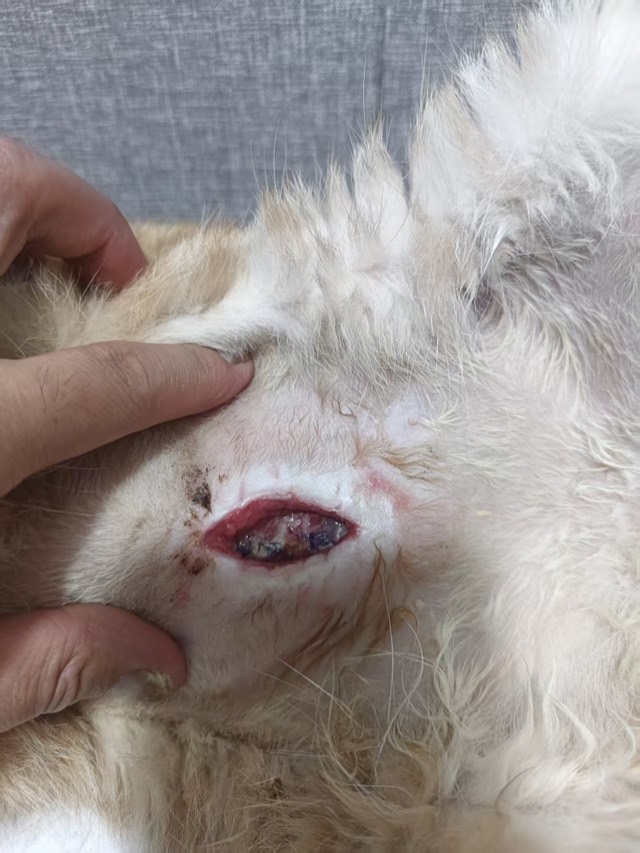
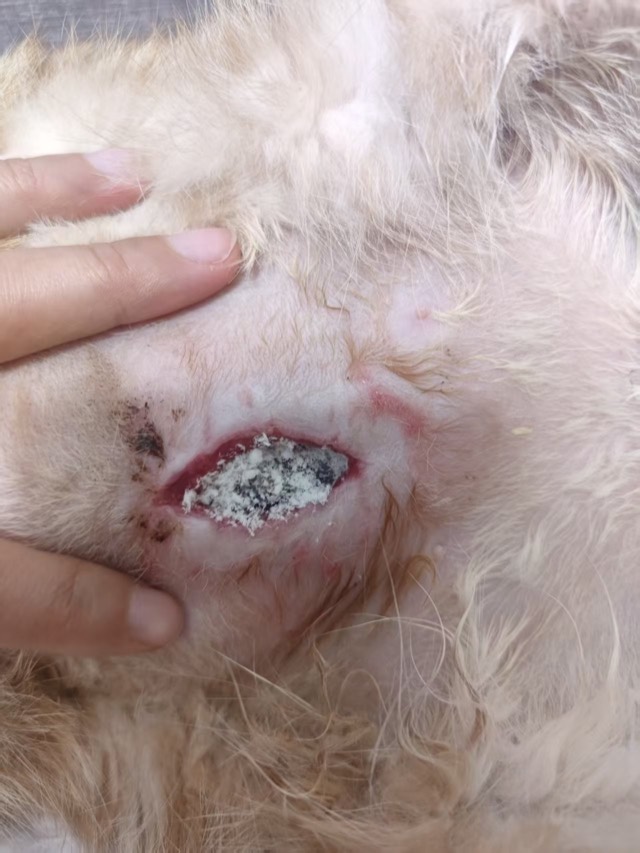
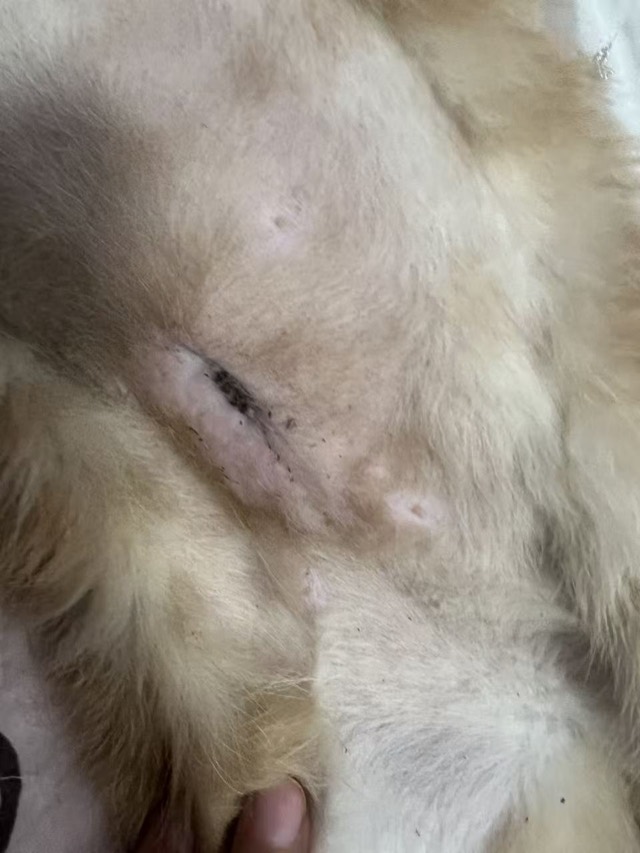
Fat Liquefaction after Bladder-Stone Surgery
After bladder-stone surgery subcutaneous fat liquefaction and non-healing wound; after thorough debridement an appropriate amount of ECM powder was placed on the subcutaneous wound surface and the wound sutured in a single application. First powder on Aug 29, second on Sep 1, and the wound consolidated on Sep 11.
Cases from partner veterinary hospitals. ECM materials are veterinary surgical materials and are applied by the treating veterinarian. See all 39 clinical cases →
Frequently asked questions
Will a dog abscess go away on its own?
Sometimes an abscess ruptures and drains by itself and the dog improves quickly, but the cavity and the bacteria are still there and it commonly fills and reforms. A ruptured abscess still needs to be opened properly, flushed and kept draining, and usually needs antibiotics.
Can I drain a dog abscess at home?
No. You cannot see how far the pocket tracks, you cannot break down the fibrous capsule, and squeezing can push infection deeper or into the bloodstream. It is also very painful, which is how owners get bitten. Warm compresses until a vet can see it are the only sensible home measure.
How do I know if my dog has an abscess or a tumour?
You cannot tell by feel, and neither can most owners. A fine needle aspirate at the clinic takes seconds and distinguishes pus from fat from tumour cells under the microscope. Abscesses are typically fast-growing, hot and painful; tumours usually are not.
How long does a dog abscess take to heal after drainage?
Most dogs are comfortable within 24 to 48 hours of drainage, the drain comes out at 3 to 5 days, and the cavity closes over 1 to 2 weeks. A cavity that was filled with a resorbable material or left to heal from the base outwards can take 2 to 3 weeks.
Does my dog need antibiotics for an abscess?
Usually yes, for 7 to 14 days, and drainage comes first — antibiotics cannot penetrate a walled-off pocket well. Because bite wounds carry a mixed bacterial population, your vet may take a sample for culture so the antibiotic is actually matched to the bacteria.
Why does my dog keep getting abscesses in the same place?
The usual reasons are incomplete drainage, a retained foreign body such as a grass awn or splinter, dead space left unfilled after drainage, an antibiotic course stopped early, or an untreated underlying problem such as dental disease. Ask your vet to review all five rather than prescribing another antibiotic.
Is a dog abscess contagious to other pets or to people?
The abscess itself is not contagious, but the bacteria inside it can be passed on through pus if another animal or a person with a break in the skin contacts it. Wear gloves when handling discharge, keep other pets away from the wound, and wash your hands afterwards.