
- 1. The recovery timeline at a glance
- 2. The first 24 hours
- 3. Five rules of incision care
- 4. Normal vs. not normal
- 5. Swelling, bruising and seromas
- 6. Stitches, staples and drains
- 7. Activity, the collar and medication
- 8. When to call the vet
- 9. Surgical wounds and dead space
- 10. Clinical cases
- Frequently asked questions
- Related guides
1. Dog surgery recovery: the timeline at a glance
| When | What is normal | What you do |
|---|---|---|
| First 12–24 hours | Groggy, wobbly, whining, unsettled. May be off food. Incision looks clean, red at the edges. | Quiet, warm, dark place. No stairs. Small amounts of water, then a light meal if the vet allows. |
| Days 2–3 | Brighter and eating again. Sleeps a lot. Incision is slightly swollen and bruised, and warm to the touch. | Short lead walks for toileting only. Start any medication on schedule. Collar on constantly. |
| Days 4–7 | Swelling starts to reduce. Bruising fades from purple to yellow-green. Skin looks dry and the edges are sealed. | Keep the wound dry. Vet recheck if one was booked. Continue to restrict activity. |
| Days 8–14 | Wound looks fully closed. Sutures or staples are removed at the appointment the vet has set. | Usually no bathing or swimming until the vet confirms the wound is fully sealed. |
| Week 2–6 | Surface is healed, deeper tissue is still remodelling. Scar strengthens gradually. | Activity is increased gradually, on the vet's schedule — not the dog's enthusiasm. |
Two caveats. The timeline shifts with the surgery: a spay or a dental is on the fast end; abdominal surgery, orthopedic surgery and tumor removal are on the slow end. And the timeline is not a diagnosis — a wound that is off-schedule in the wrong direction is a phone call, not a waiting game.
2. The first 24 hours at home
- Keep it quiet and warm. A dark, draught-free room, a soft bed within sight of you. Anesthesia wears off unevenly, and dogs can be unsteady for 12–24 hours.
- Confine movement. No stairs, no jumping on the sofa, no slippery floors. Help large dogs in and out of the car.
- Offer water first, then food. Small amounts, and only what the clinic told you. Vomiting after anesthesia is common and usually settles; persistent vomiting is not.
- Look at the incision once, properly, while the dog is calm. Photograph it. That first photo is your baseline, and comparing photos over the next week is far more reliable than memory.
- Put the collar on before the dog is fully awake. The first thing a groggy dog does is lick the wound.
- Do not disturb the dressing unless the clinic told you to. If it gets wet or soiled, call and ask — do not improvise.
3. Five rules of incision care
- Keep it dry. No bathing, no swimming, no rain, no wet grass. Unless told otherwise, do not clean the incision with anything at all — a dry, sealed wound is the goal.
- Keep the dog away from it. An Elizabethan collar (or an inflatable collar, if your vet approves one for this wound's location) worn continuously — at night, and any time you cannot watch. Licking introduces bacteria and destroys the seal.
- Keep it covered only if instructed. A light protective dressing is often used, but the dressing itself can trap moisture and harbour bacteria. Change it exactly when the clinic says, and check the wound at each change.
- Restrict activity properly. No running, jumping, stairs, rough play with other pets, or off-lead exercise. Stretching the wound is the main cause of a dehiscence (a wound that opens).
- Look at it twice a day. Same time, same light, ideally with a photo. You are looking for change: in size, colour, odour, discharge and the dog's comfort level.
The most common owner error after surgery is not the wound care. It is letting the dog off the lead "because he seems fine". Dogs feel better long before the tissue has regained strength.
4. Normal vs. not normal after surgery
| What you see | Usually normal | Call the clinic |
|---|---|---|
| Redness at the wound edge | Mild, fading by day 3–4 | Spreading outward, or deepening after day 4 |
| Swelling | Mild, firm, symmetrical along the incision, reducing after day 3 | Increasing, hard, lumpy, or a soft fluctuant pocket forming |
| Bruising | Purple-black at first, turning yellow-green as it fades | Bruising that keeps expanding, or a rapidly growing blood-filled swelling |
| Discharge | A tiny amount of clear or blood-tinged fluid in the first 24–48 hours | Pus, a bad smell, or any discharge after day 3 |
| Wound edges | Meeting neatly, sealed by day 5–7 | Gaping, or a suture that has come loose |
| Pain | Settling steadily from day 2 | Increasing pain, or a dog that suddenly resists being picked up |
| General health | Sleepy for 24–48 hours, then gradually brighter | Fever, not eating for over 24 hours, vomiting, collapse, breathing changes |
5. Swelling, bruising and seromas
Some swelling is expected: tissue that has been cut and closed becomes inflamed. What matters is the trend and the character of the swelling.
- Settling swelling is firm, symmetrical along the wound, warm, and largest on day 2–3 before reducing.
- A seroma is a soft, fluid-filled pocket under the incision, usually appearing 3–7 days after surgery. It forms because a space was left under the skin and tissue fluid collects there. Many resolve on their own over 2–3 weeks; a large or tense one is usually drained by the vet and, if it keeps refilling, the underlying dead space is what has to be dealt with.
- A hematoma is blood rather than serum, and it appears faster. A rapidly growing, tense swelling after surgery is a call today.
- An abscess is hot, painful, and usually has fever and lethargy with it — see Dog Abscess.
Do not squeeze, massage or press on a post-operative swelling to "see what comes out". Warm or cold compresses should only be used if the clinic asks for them.
6. Stitches, staples and drains
| Closure | Typical removal | Notes |
|---|---|---|
| Skin sutures (nylon, silk) | 7–14 days depending on site | Remove at the clinic. Do not cut them yourself — a wound that opens on day 9 is far worse than a 5-minute appointment. |
| Skin staples | 7–14 days | Quick to remove. Keep them clean and dry; they can catch on bedding. |
| Absorbable sutures (buried) | No removal | Common in spays and in many soft-tissue surgeries. The dog may still need a collar for 10–14 days. |
| Drain (often Penrose) | 2–5 days | A drain is deliberate: it lets fluid out so it does not collect. Do not pull it out; keep the opening clean and report any change in the fluid. |
Stitch removal is judged partly by the calendar and partly by how the wound looks. If the appointment lands early and the wound is not sealed, the vet will leave them a few more days — that is normal, not a failure.
7. Activity, the collar and medication
Activity. Restriction is not optional and it is not "until the dog seems happy".
- Dogs: lead walks for toileting only, 2–3 times a day, for the first 7–10 days; then gradually longer walks; off-lead exercise typically only after the recheck confirms healing. Orthopedic surgery and abdominal surgery follow the surgeon's own schedule, which may be 6–12 weeks of controlled exercise.
- Cats and small dogs: no jumping on or off furniture; use a low litter tray or a ramp.
- All species: no stairs if it can be avoided, no swimming, no hydrotherapy, no daycare or boarding until cleared.
The collar. Continuous wearing, including overnight. Soft inflatable collars are acceptable for many wounds but not for wounds on the head, face, ears, neck, front paws or tail — those need a full Elizabethan collar. A collar that "seems unnecessary because the dog is not licking" is the collar that comes off the day the wound gets infected.
Medication. Give pain relief and antibiotics exactly on schedule, and finish the full course. Do not add human painkillers — ibuprofen and paracetamol (acetaminophen) are toxic to dogs. If your dog seems more painful than expected, that is a call to the clinic, not a reason to double the dose.
Appetite and toileting. Mild constipation for 24–48 hours after anesthesia is common. Not eating for more than 24 hours, vomiting repeatedly, or not passing urine is a call. Report any change in drinking volume, since some medication affects it.
8. When to call the vet during recovery
- Fever, shivering, lethargy that is getting worse rather than better
- The wound is opening, or a suture or staple has come loose
- Discharge that is purulent, dark or foul-smelling
- Swelling that is increasing after day 3, or a fast-growing tense swelling
- The skin around the wound turning dark, grey or black
- Not eating for over 24 hours, repeated vomiting or diarrhoea
- Not urinating, straining to urinate, or a wound near the urinary tract that is wet with urine
- Sudden pain, screaming when picked up, or a limb that is not being used
- Difficulty breathing, pale gums, or collapse — go now, do not telephone
- Bleeding that does not stop with a few minutes of gentle pressure
Nobody at a veterinary clinic minds a phone call that turns out to be nothing. They mind a wound that has been infected for four days.
9. Surgical wounds and the dead-space problem
Post-operative complications are not random. A large share come back to the same three things: dead space left under the incision (fluid collects, and the wound either swells into a seroma or becomes an abscess), devitalised tissue at the wound base, and a surface that has to heal by second intention because the wound could not be closed.
That is precisely the step our ECM regenerative materials are designed for. Where a wound has an obvious cavity or a large tissue defect after resection, the cavity can be filled with a material the body resorbs while new tissue grows into it, rather than being left empty. These are clinic-supplied veterinary surgical materials, used by the treating veterinarian during the operation:
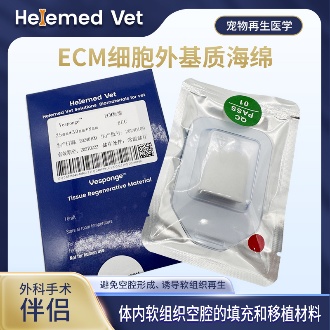
ECM Sponge
ECM filling sponge and ECM cavity-filling biomaterials: for internal soft-tissue cavity filling, providing long-lasting space occupation and inducing regeneration to achieve a soft-tissue graft effect; also an ideal ECM Tumor Filling Material for dead-space repair after tumor resection, and a routine companion to ECM trauma dressings in cavity and fistula wounds.
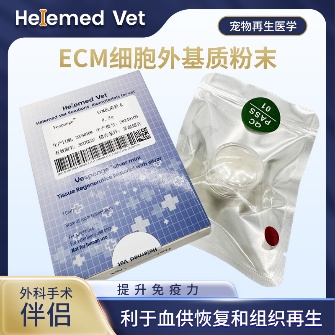
ECM Antibacterial Powder
ECM bioscaffold powder — an extracellular matrix (ECM) based antibacterial and inhibitory powder: widely used as ECM trauma dressings on infected internal/external wounds, fresh wounds, burns and crush injuries to markedly improve blood supply, accelerate healing, inhibit infection and reduce complications; it is also an ECM hemostatic material that stops capillary bleeding. How to use: after debridement, take a small amount of powder with forceps and apply to the wound surface, moisten with saline (moist wound healing) and bandage; apply once every 5 days — daily debridement is not required.
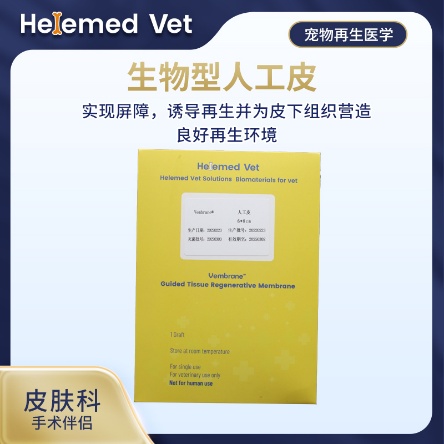
Biosynthetic Artificial Skin (6×8cm)
Artificial skin and ECM trauma dressing for external skin grafts: provides a barrier and induces regeneration, creating a good regenerative environment for subcutaneous tissue in burns and large-area skin loss.
The sponge fills soft-tissue cavities and dead space after tumor resection, dead-space closure or cavity wounds; the antibacterial powder is applied to the debrided wound bed and dressed; artificial skin covers larger skin defects such as grafts after wide resection and burns. Ask your surgeon whether these materials suit the procedure.
10. Clinical cases
Two cases from our partner hospitals show the two directions a post-operative wound can take: an infection after orthopedic surgery that needed repeated application cycles, and a prophylactic application during a total mastectomy where the tissue defect was planned for in advance.
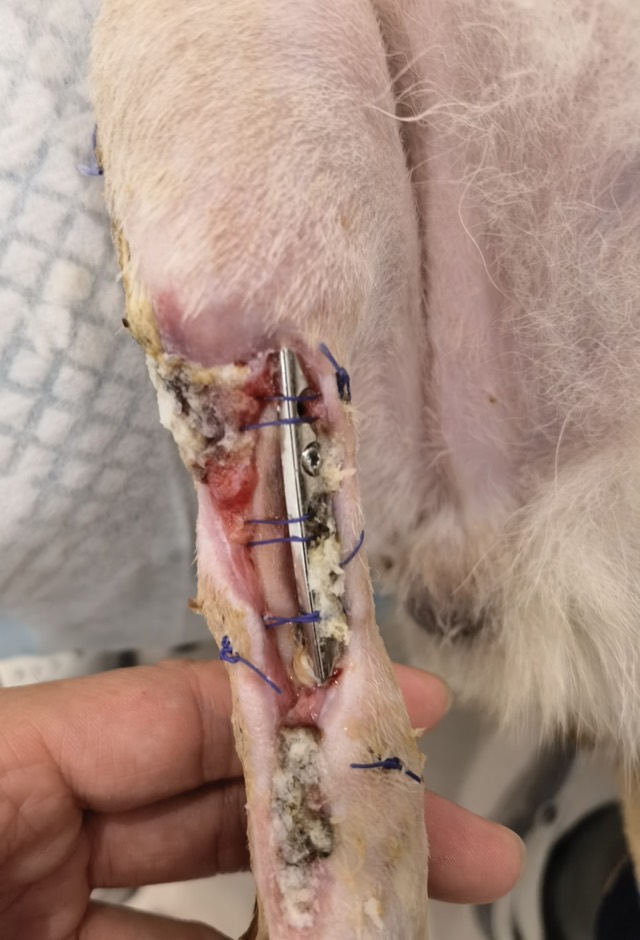
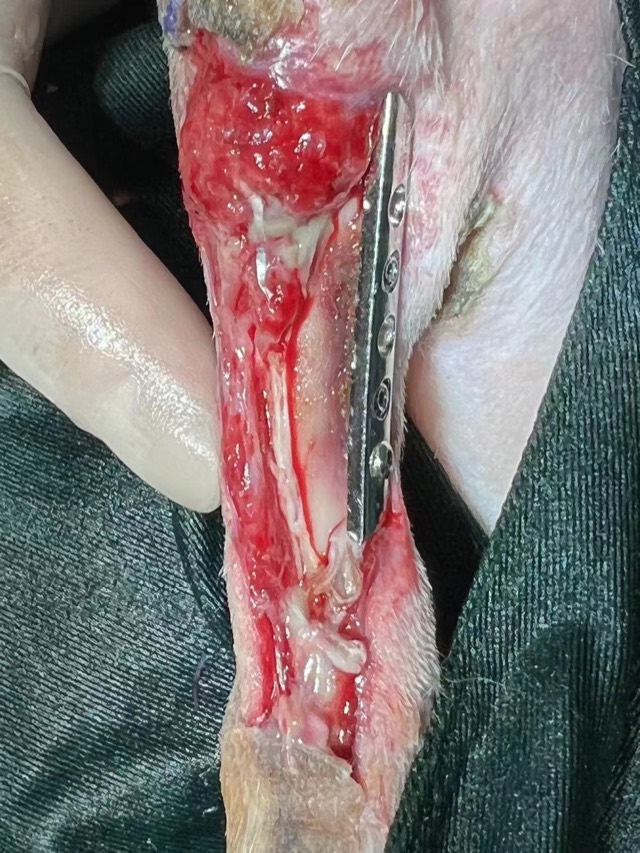
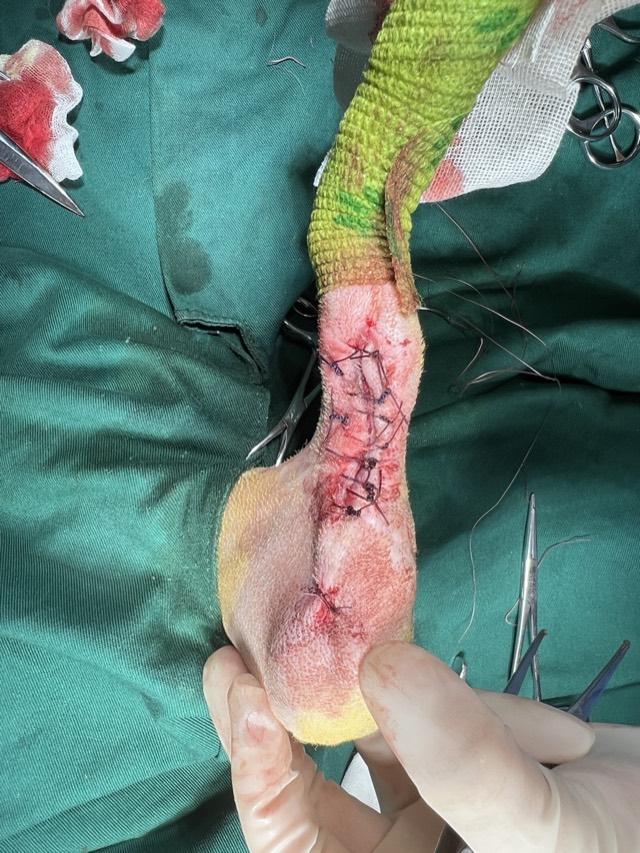
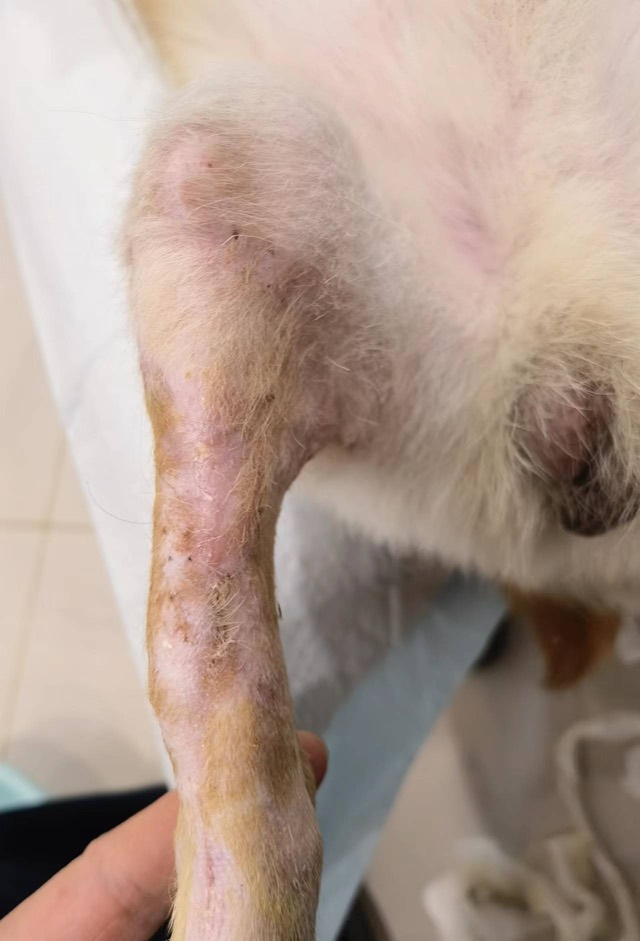
Post-Orthopedic-Surgery Infection
Post-orthopedic-surgery infection treated with ECM Antibacterial Powder; after 3 application cycles (15 days) the bone plate was removed and a skin flap sutured, and the wound fully recovered.
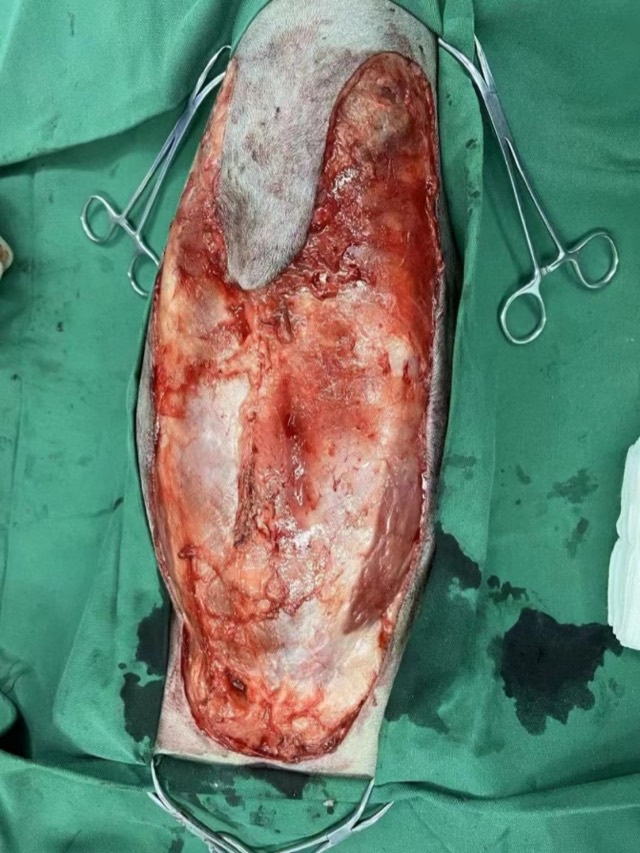
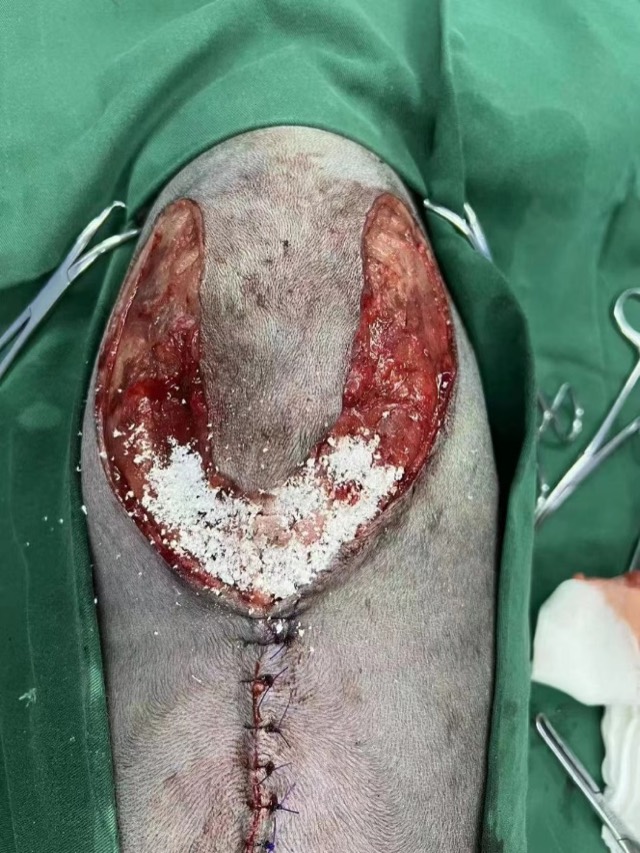
Prophylactic Total Mastectomy Application
The complication rate of total mastectomy is second only to bite cases, so prophylactic application is especially recommended: lay a thin layer of ECM powder subcutaneously in the triangular, high-tension area; use ECM Sponge prophylactically in the inguinal region to avoid cavities and accelerate tissue regeneration.
Cases from partner veterinary hospitals. ECM materials are veterinary surgical materials and are applied by the treating veterinarian. See all 39 clinical cases →
Frequently asked questions
How long does it take a dog to recover from surgery?
A routine spay or minor procedure: bright within 48 hours, wound sealed by 7 to 10 days, stitches out at 10 to 14 days, normal activity after 2 weeks. Abdominal, tumor and orthopedic surgery are slower — surface healing may be 2 weeks while full strength takes 6 to 12 weeks, which is why activity restriction is staged.
Should I clean my dog’s incision?
Usually no. A clean, dry, sealed incision needs nothing at all. Do not use disinfectants, alcohol, hydrogen peroxide or human creams. If the clinic has told you to clean or flush it, use only what they specified, and if the wound becomes soiled or wet, call and ask before improvising.
What does an infected incision look like?
Spreading redness after day 3, increasing swelling or hardness, pus or foul-smelling discharge, the wound edges separating, dark or grey skin, and a dog that is feverish, lethargic or off food. An infected incision is a recheck today — antibiotics alone will not fix a wound with dead space or a collection under it.
Is swelling normal after surgery?
Mild, firm swelling along the incision that peaks around day 2 to 3 and then reduces is normal, as is bruising that fades from purple to yellow-green. Swelling that keeps increasing, is tense or fluctuant, or appears suddenly is not — that may be a seroma, a hematoma or an abscess, and it needs to be assessed.
How do I stop my dog licking the incision?
A correctly fitted Elizabethan collar worn continuously, including at night, until the vet says the wound has healed. A soft or inflatable collar can work for some surgical sites but not for the head, neck, ears, paws or tail. If the dog can still reach the wound with the collar on, it is the wrong size or the wrong type.
When can my dog go for a walk or swim after surgery?
Lead walks for toileting are usually fine from day 1 to 2. Longer walks are added at the recheck, and off-lead running, jumping and swimming wait until the surgeon confirms the wound is fully healed — commonly 2 weeks for soft-tissue surgery and 6 to 12 weeks after orthopedic surgery.
My dog has a soft lump under the incision. Is it a seroma?
It may be. A seroma is a soft, fluid-filled pocket that appears 3 to 7 days after surgery where dead space was left under the skin. Many resolve over 2 to 3 weeks; a large or tense one is drained by the vet. A lump that is hot and painful with fever and lethargy is more likely an abscess and needs to be seen sooner.
Can I give my dog painkillers at home after surgery?
Only the medication the clinic prescribed, at the dose prescribed, and for the full duration. Never give human painkillers: ibuprofen, naproxen and paracetamol (acetaminophen) are toxic to dogs. If you think the pain is not controlled, telephone the clinic — do not add a second drug.