
- 1. What a dog hot spot is
- 2. Why they appear overnight
- 3. What triggers a hot spot
- 4. Signs and how to tell them apart
- 5. How urgent is it?
- 6. How a vet treats a hot spot
- 7. Home care and what to avoid
- 8. When a hot spot becomes an open wound
- 9. Preventing the next one
- 10. Clinical cases
- Frequently asked questions
- Related guides
1. What a dog hot spot is
A hot spot is a self-inflicted skin injury. Something makes a small area of skin itch — a flea bite, a bit of trapped moisture, an ear infection, an anal gland problem — and the dog responds by licking, scratching and chewing that one spot with real intensity. The friction and the saliva macerate the skin, bacteria that normally live harmlessly on the surface (usually Staphylococcus pseudintermedius) multiply in the damaged skin, and the inflammation gets worse, which makes it itch more, which makes the dog chew more.
That loop is the whole disease. It is called the itch–scratch cycle, and every part of treatment is aimed at breaking it.
Key point: a hot spot is not contagious and it is not "just a rash". It is acute, exuding, bacterial dermatitis that will keep expanding as long as the dog can reach it.
2. Why they appear overnight
The speed is the diagnostic feature. A 2 cm itchy spot can become a 10 cm raw, weeping lesion in 6–12 hours, because the dog keeps working at it. Owners regularly report that the dog was completely normal at bedtime and had a large weeping sore by breakfast — that is entirely typical, not an exaggeration.
Hot spots are also seasonal in a very specific way: they peak in warm, humid weather, and they peak in dogs with thick or double coats — Golden Retrievers, Labradors, German Shepherds, Saint Bernards, Newfoundlands, Rottweilers — because moisture trapped against the skin sets the whole thing off.
3. What triggers a hot spot
| Trigger | Why it starts the itch | What to check |
|---|---|---|
| Flea allergy dermatitis | A single flea bite can cause intense itch in an allergic dog. The classic site is the lower back, tail base and hindquarters. | Flea dirt in the coat, even if you see no fleas. Year-round flea control is the fix. |
| Environmental allergy (atopy) | Pollen, dust mites and moulds cause seasonal or year-round itch, most often on the face, paws, armpits and groin. | Seasonal pattern, licking of paws, ear infections. |
| Ear infection | Otitis externa is itchy and painful; the dog scratches the ear and the side of the head, and creates a lesion right there. | Head shaking, ear odour, discharge. Very commonly missed as the cause. |
| Anal sac disease | Impacted or infected anal sacs make the dog scoot and chew the tail base and hindquarters. | Scooting, licking the rear, pain when sitting. |
| Trapped moisture and matted coat | Swimming, a bath that did not dry to the skin, or a dense undercoat keeps the skin warm and wet. | Hot spots on the neck, back, flanks and around the tail base after water contact. |
| Food allergy | Less common than the others, but a genuine cause of chronic itch, often with ear and gut signs. | Non-seasonal itch, recurrent ear infections, loose stool. |
| Arthritis or a painful joint | The dog licks the painful area, and a hot spot forms over the joint. | Stiffness, reluctance to jump, licking of a limb. |
| Foreign body or a small injury | A grass awn, thorn or splinter in the coat starts the itch in that spot. | Part the hair and look — this is worth 30 seconds before anything else. |
Finding the trigger is not optional, because a hot spot treated without addressing the cause comes back in the same place within weeks. In one large survey of canine skin disease, flea allergy and atopy together account for the majority of recurrent hot spots.
4. Signs of a hot spot, and what else it could be
- A rapidly appearing, well-defined patch that is hairless, red, raw and wet
- Clear or pus-like exudate that mats the surrounding hair and may smell unpleasant
- Marked pain — most dogs will not let you touch it, and may snap
- The dog cannot leave it alone: chewing, licking, scratching, sometimes to the point of making it bleed
- Size can double within a day; the edge is usually sharply defined against normal skin
Several other conditions look similar and are treated completely differently, which is why a diagnosis matters:
| Condition | How it differs |
|---|---|
| Hot spot (acute moist dermatitis) | Sudden, exuding, intensely itchy, self-inflicted, hairless patch with a sharp edge |
| Superficial pyoderma | More widespread crusts, papules and circular scaling lesions; develops over days, not hours |
| Malassezia (yeast) dermatitis | Greasy, musty-smelling, thickened, often dark-pigmented skin; very itchy but not raw and weeping |
| Ringworm | Circular bald patches with a scaly rim; slow, and contagious to people and other pets |
| Demodicosis / sarcoptic mange | Patchy hair loss, scaling, often on the face and feet; may be very itchy |
| Contact dermatitis | Affects areas that touch the irritant — belly, feet, muzzle — and resolves when exposure stops |
5. How urgent is a hot spot?
Most hot spots are not emergencies, but they should be seen within 24 hours, because they spread fast and become far more painful and harder to treat if they are allowed to grow. The size of the lesion is the main driver of how much sedation is needed to treat it comfortably.
Call immediately if the dog also has a fever, is lethargic or off food (a deep infection may be developing), if a large area of skin is involved, if the lesion is on the face or around an eye, or if your dog has a condition or medication that suppresses the immune system.
6. How a vet treats a hot spot
- Clip and clean. The hair over and around the lesion is clipped away so the surface can dry and be treated. Clipping is also how the true size becomes obvious — often much bigger than the owner expected. The skin is then cleaned gently with an antiseptic solution.
- Pain relief and, if needed, sedation. These lesions hurt. A dog that will not allow handling is treated under sedation rather than held down, which is safer for everyone.
- Break the itch–scratch cycle. This is the single most important step: usually a short course of anti-inflammatory steroids (topical, oral or injectable), which stops the itch within hours. Without it the dog simply re-opens the wound.
- Treat the infection. Topical antibacterial therapy is the mainstay for superficial lesions. Systemic antibiotics are used for deep infection, large lesions or when topical treatment alone is impractical — and only for the full prescribed course.
- Treat the trigger. Flea control, ear treatment, anal sac expression, allergy management, an appropriate diet trial. Without this step the lesion returns.
- Protect the area. An Elizabethan collar, and a light dressing where the lesion is in a place the dog can reach, so it can dry and heal.
With that combination, most hot spots stop spreading within 24 hours, dry up in 3–5 days and are substantially healed in 7–10 days. Hair regrowth over the area takes longer, often 4–8 weeks.
7. Home care, and what not to do
Do:
- Keep the area clipped, clean and dry. Moisture is the enemy.
- Use the medicated shampoo, spray or ointment your vet prescribed, at the frequency prescribed.
- Use the Elizabethan collar continuously until the vet says otherwise. "Only when I am watching" does not work.
- Keep the dog out of water — no swimming, no bathing the lesion, no paddling pools.
- Keep treating the underlying trigger: flea prevention all year, ear medication to completion, allergy plan.
Do not:
- Do not apply human antiseptics, alcohol, hydrogen peroxide, or human antibiotic or steroid creams. Many are irritant, some are toxic if licked, and steroid creams used alone on an infected lesion make the infection worse.
- Do not bandage the lesion airtight. A hot spot needs to dry; an occlusive dressing keeps it moist and feeds the bacteria.
- Do not shave with a blade against the skin or use scissors close to inflamed skin. Clipping an angry hot spot is a job for clippers and, often, for a sedated dog.
- Do not assume it will "dry up on its own". Untreated, they grow, and a large wet lesion is much harder to treat.
8. When a hot spot becomes an open wound
When the surface skin is gone and the lesion is exuding heavily, you are no longer managing a rash — you are managing an open skin wound. The priorities change, and they are the same ones that apply to any dog wound:
- Control the infection, and get the exudate off the skin so it does not macerate more of it.
- Stop the self-trauma, which means the collar and adequate pain relief.
- Cover the defect so the surface can heal and new skin can grow in from the edges.
Two things are worth knowing here. First, a large raw surface that is not covered dries, cracks and heals much more slowly than one kept in a moist, protected environment. Second, where a substantial area of skin has been lost, the defect may be too large to close by contraction alone, and reconstruction — a skin graft or a synthetic skin substitute — becomes the option. That is the situation our artificial skin and ECM dressings are used in.
Materials used when the skin surface is lost
Our ECM regenerative materials are veterinary surgical materials used by the treating veterinarian after the lesion has been cleaned and debrided. For an ulcerated, exuding surface the powder is applied to the wound bed and dressed; where a large area of skin is missing, artificial skin provides a barrier and a scaffold for the surrounding skin to regenerate into.

Biosynthetic Artificial Skin (6×8cm)
Artificial skin and ECM trauma dressing for external skin grafts: provides a barrier and induces regeneration, creating a good regenerative environment for subcutaneous tissue in burns and large-area skin loss.

ECM Antibacterial Powder
ECM bioscaffold powder — an extracellular matrix (ECM) based antibacterial and inhibitory powder: widely used as ECM trauma dressings on infected internal/external wounds, fresh wounds, burns and crush injuries to markedly improve blood supply, accelerate healing, inhibit infection and reduce complications; it is also an ECM hemostatic material that stops capillary bleeding. How to use: after debridement, take a small amount of powder with forceps and apply to the wound surface, moisten with saline (moist wound healing) and bandage; apply once every 5 days — daily debridement is not required.
Ask your veterinarian whether these materials suit your dog's lesion; they are supplied to veterinary clinics and hospitals.
9. Preventing the next hot spot
- Year-round flea control with a product that actually works in your area. This is the highest-yield single measure.
- Dry the coat to the skin after swimming or bathing, especially on thick-coated dogs. Pay attention to the neck, behind the ears, the armpits and around the tail base.
- Keep the coat groomed and free of mats. Matted hair holds moisture against the skin.
- Check ears weekly and treat ear disease promptly — a large share of head and neck hot spots start as ear infections.
- Handle anal sac problems early, and ask your vet about whether your dog needs them expressed routinely.
- Work up chronic itch properly. If your dog itches most months of the year, the answer is an allergy investigation, not another course of steroids.
- Act on the first small spot. A 1 cm lesion treated today is far easier than a 10 cm lesion treated tomorrow.
10. Clinical cases
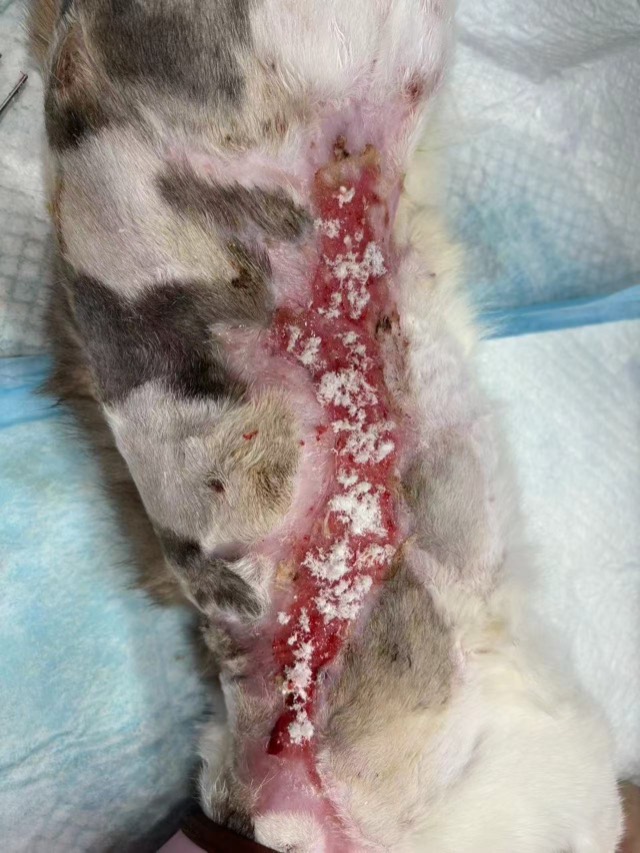
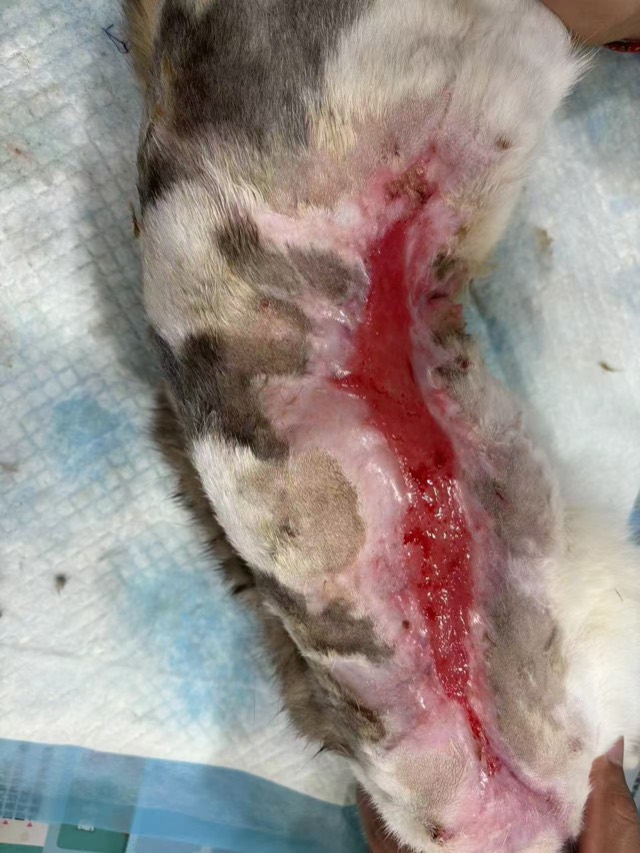
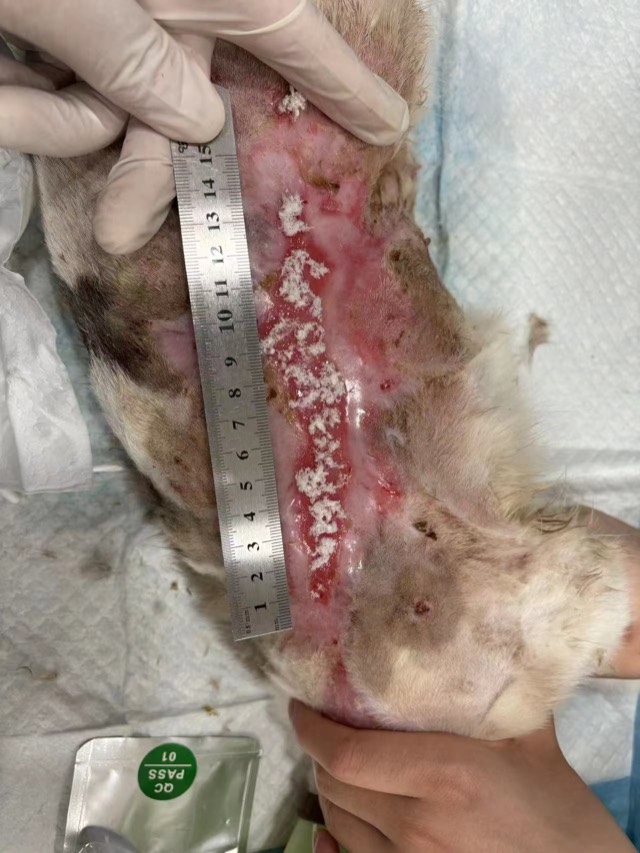
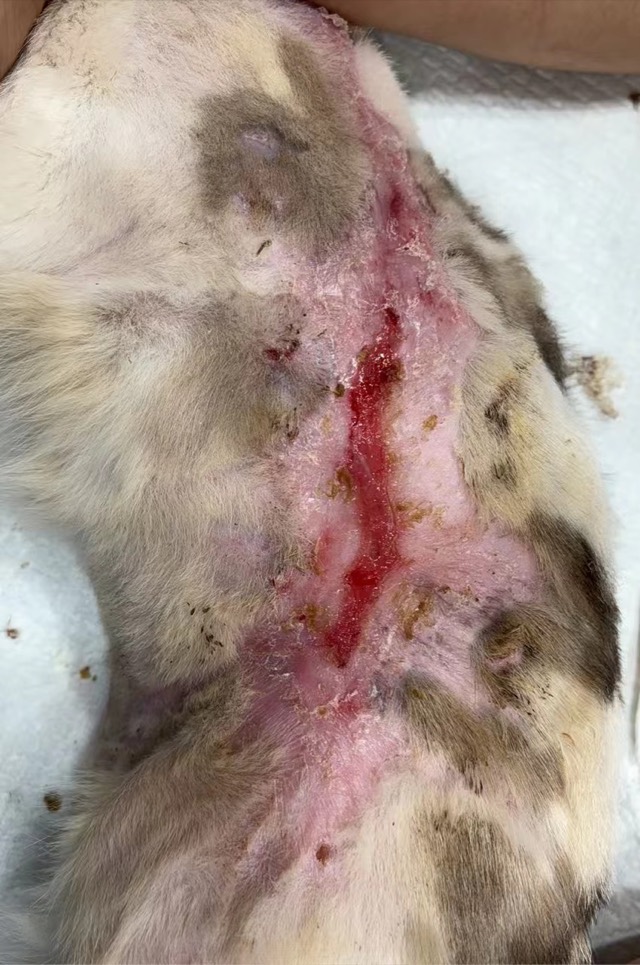
When a skin lesion has been left long enough to lose its surface, the treatment becomes wound management. These two cases from our partner hospitals show a large raw skin surface being managed with ECM materials — one after extensive ulceration, one a large-area burn.
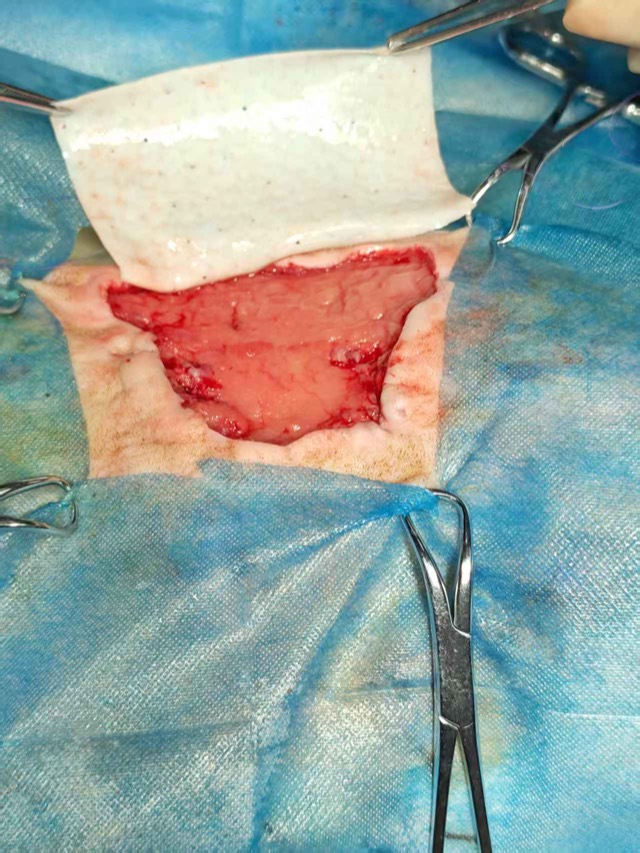
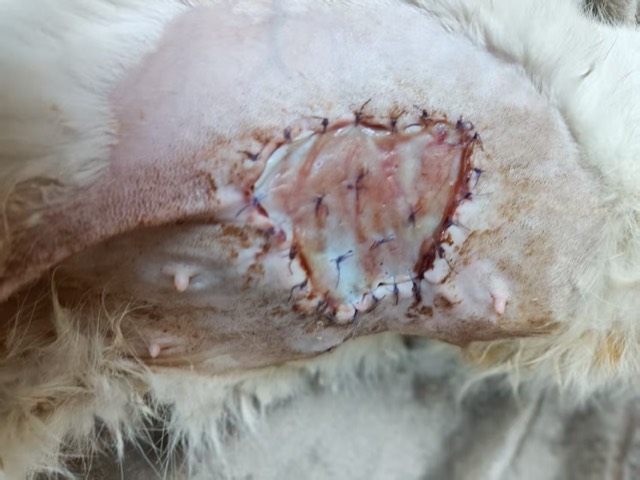
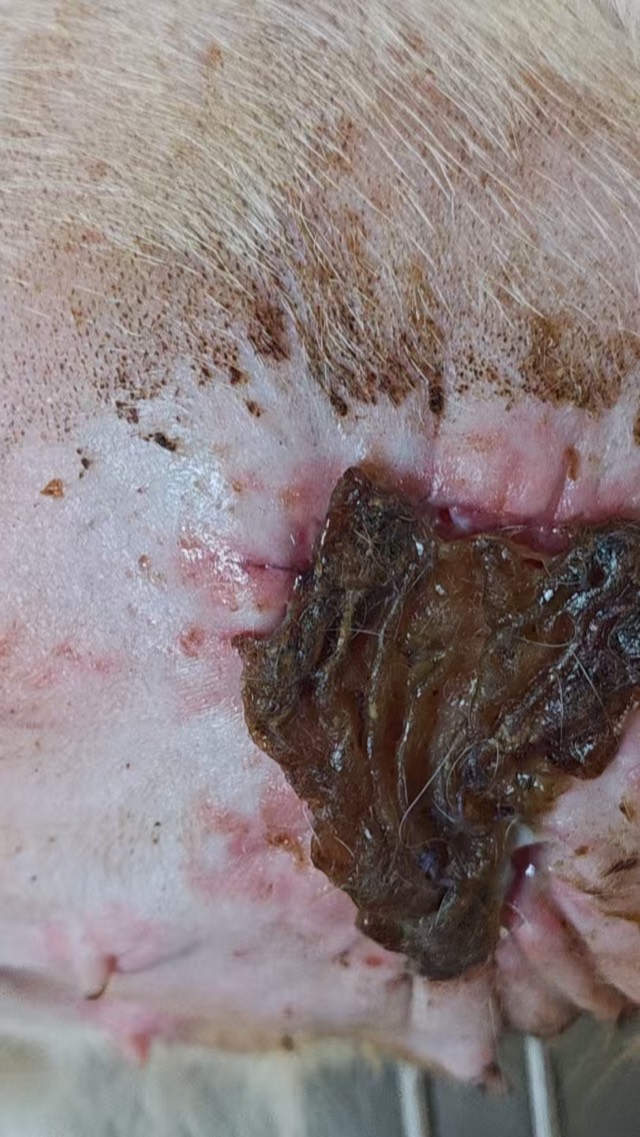

Artificial Skin for Skin-Defect Repair
A stray cat developed mammary ulceration and infection after giving birth; after Biosynthetic Artificial Skin grafting, only light daily cleaning and antibiotics were needed — simple care. The artificial skin sloughed off naturally on Oct 30 and the wound basically recovered by Nov 7.
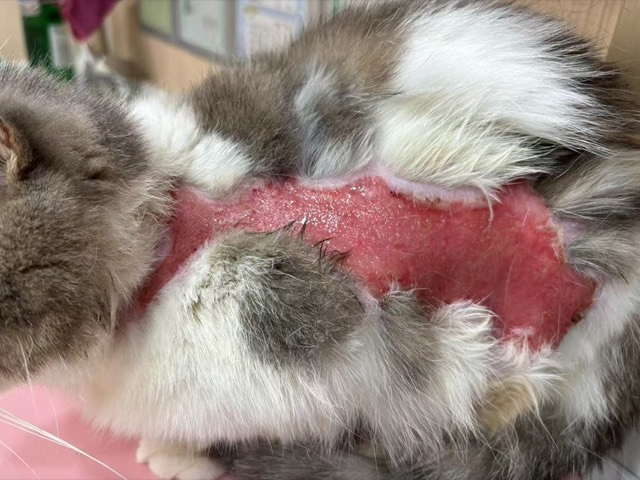
Large-Area Burn (approx. 40cm)
An adult cat with an approx. 40cm large-area burn on its side. ECM Antibacterial Powder was first applied on Sep 11, 2024; after 5 days the wound was markedly reduced with no infection. Areas hard to bandage were fixed with skin staples or a stitch at each corner. The wound kept shrinking with each application and gradually recovered after Oct 8.
Cases from partner veterinary hospitals. ECM materials are veterinary surgical materials and are applied by the treating veterinarian. See all 39 clinical cases →
Frequently asked questions
What does a hot spot look like on a dog?
A sharply defined, hairless, red, raw and weeping patch that appeared within hours. The surrounding hair is often matted with discharge, the area is painful to touch, and the dog will not stop licking or chewing it.
What causes hot spots on dogs?
Almost always an underlying itch trigger: flea allergy dermatitis, environmental allergy, an ear infection, anal sac disease, trapped moisture in a thick coat, food allergy, or joint pain the dog licks. Treating the lesion without finding the trigger means it returns.
Do hot spots go away on their own?
Some small ones dry up, but most spread quickly because the dog keeps traumatising the area, and they frequently become deeper infections. They should be assessed within 24 hours. Treated properly, most stop spreading within a day and heal in one to two weeks.
Can I use hydrocortisone cream on a dog hot spot?
No. A human steroid cream used alone on an infected, weeping lesion can worsen the infection, and it will be licked off and swallowed. Hot spots need veterinary assessment, appropriate topical antibacterial treatment and, usually, an anti-itch medication prescribed by your vet.
How do I stop my dog licking a hot spot?
An Elizabethan collar worn continuously until the vet says the lesion has healed — including at night and whenever you cannot watch the dog. Licking is what created the lesion and what keeps it open. Anti-itch medication is what makes the collar tolerable.
Are hot spots contagious to other pets?
No. A hot spot is self-inflicted skin damage with secondary bacterial infection, so it does not pass between animals. Ringworm, which can look superficially similar, is contagious — that is one reason a vet should look at any new skin lesion.
How long does a hot spot take to heal?
With treatment, spreading usually stops within 24 hours, the surface dries in 3 to 5 days and the lesion is largely healed in 7 to 10 days. Hair regrowth over the area commonly takes 4 to 8 weeks.